The Loss You Don’t Notice
Most of what you think is “you” isn’t. Not your opinions, not your fears, and not your interpretations of why someone didn’t text back. Most of it was installed before you had a chance to choose.
A few years ago, someone I cared about stopped talking to me. Not dramatically, just slowly. I told myself they were distant and that they’d reach out when ready. They were indeed going through a quiet emergency—a parent’s illness, financial stress.
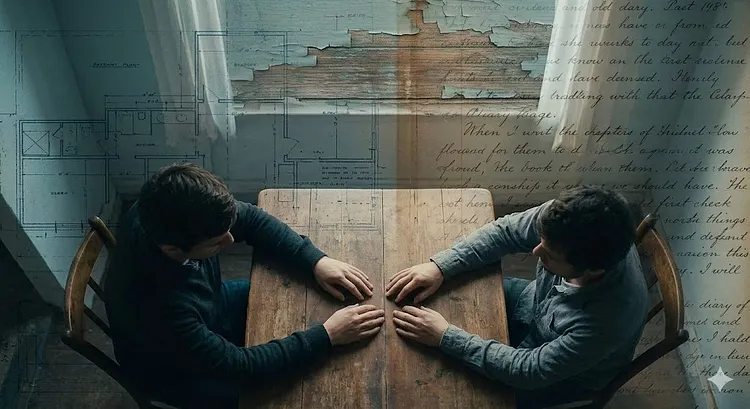
What I didn’t see was that my matching distance and silent refusal to ask made it worse. They read my silence as rejection, and I read theirs as abandonment. Two people, both certain, both wrong. By the time I understood, the door had closed—not with an argument, but with an absence.
The Crack of Inheritance
The shift didn’t come from a big idea. It came from wondering why we eat “three square meals”. If something that basic was inherited until it felt like truth, what else is? Beliefs about silence, respect, and what it means when someone pulls away. By the time you ask “who am I?”, most of the answer is already installed.
Psychologist Emily Pronin calls this the bias blind spot: the belief that everyone else is biased, but you see things clearly. You can spot your friend’s confirmation bias, but your own certainty feels like truth. I thought I was protecting my dignity and seeing clearly, but I was wrong. Bias doesn’t feel like bias; it feels like clarity.
The Mechanism
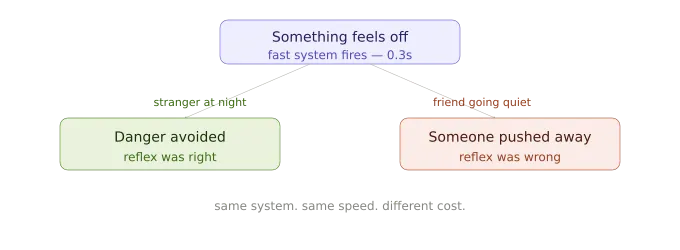
There’s a part of you that decides before you finish thinking. It reads silence as rejection and distance as threat. It’s fast, efficient, and kept our ancestors alive.
The problem is that this system doesn’t know the difference between a real threat and a tired human being going through something they can’t explain. It always fills the gap with a story that protects you—even if that story costs you the relationship.
One Interruption
There’s no complex system for this. Just one question. When you feel the emotional spike, pause for three seconds. Ask:
Is this mine, or is this borrowed?
Is this emotion mine. Or did I inherit this way of seeing without ever choosing it?
The question doesn’t give you an objective answer. It does something more important: it slows you down before you act on something you didn’t examine. You gain hesitation. And hesitation at the right moment is what keeps you from turning a misunderstanding into a loss.
Most relationships end in interpretations both people were sure were true. So the next time you’re certain about a silence or a shift, pause long enough to question the certainty. You won’t always get a better answer, but sometimes you’ll stay in the room long enough to find out what was actually there.