You needed something. You went to get it. The person who could help you treated you with a particular kind of thinness—not hostile, just absent. As if serving you was interrupting something more important. As if you’d walked into the wrong room and hadn’t been told yet.
You left with what you came for. But you also left carrying something extra: a low-grade unsettledness you couldn’t quite name. Was it how you were dressed? How you spoke? Did you do something wrong?
You didn’t. But the question itself is worth examining, because the fact that you asked it at all reveals something about how conditional courtesy works, and what it takes from the people on the receiving end of it.
The Mechanism No One Explains
In her 1983 study of service workers, sociologist Arlie Hochschild identified what she called emotional labour—the professional management of feeling as a job function. Every customer-facing role requires it. A pharmacist, a shopkeeper, and a bank teller are all implicitly expected to manage their emotions in the service of the interaction. The question is whether the institution they work within gives them the resources to do that sustainably.
Most don’t. Research consistently shows that workers in under-resourced, insecure, low-wage environments develop what’s termed surface acting—the performance of minimum required warmth without genuine engagement. It isn’t a choice, exactly. It is what depletion looks like from the outside. And depletion, in these environments, is the default condition.
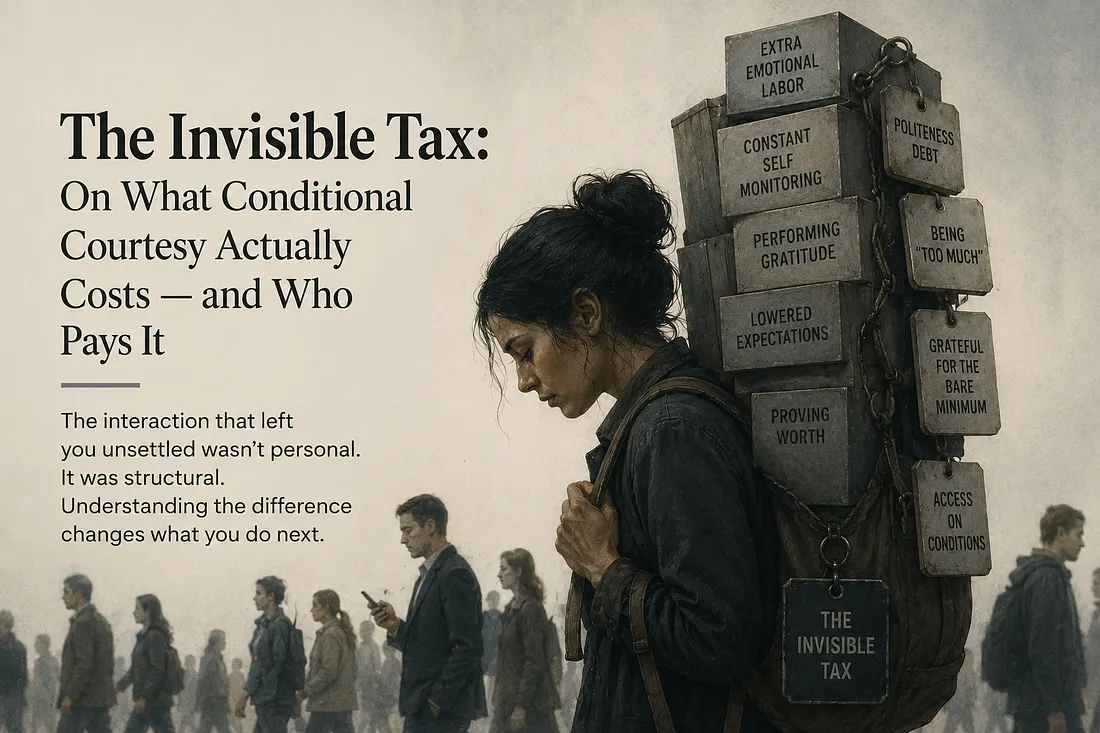
The result on the customer’s side is a kind of invisible tax. You pay it in the form of attention withheld, explanations not volunteered, apologies never offered, ten minutes in a chair with no acknowledgement. None of it shows up on the receipt. But it costs something real—in time, in dignity, in the small erosion that happens every time you are treated as less than a person in an interaction designed to serve you.
“The most expensive thing in a precarious service environment isn’t the product. It’s the dignity that gets rationed in the process of delivering it.”
Who Bears the Tax
There is a second layer. In environments where workers have little job security and fewer institutional protections, a sorting pattern emerges, studied across service industries in both developed and developing economies. Courtesy gets allocated where return seems most likely. Customers who signal economic power, who look like they have alternatives, who appear capable of extracting accountability, are treated differently. Not always consciously, but consistently.
The customers who bear the invisible tax most reliably are the ones the system has already decided have no leverage:
- Young
- Unfamiliar
- Unaccompanied
- Visibly uncertain
These are the people for whom the transaction is more urgent, who need the thing badly enough that they’ll absorb whatever comes with getting it.
Knowing this will not stop the tax from being charged, but it changes your relationship to it. The shift from “why did they treat me that way” to “what system produced that interaction” is not just intellectual; it is protective. It removes the question of your worth from an equation where it was never actually the variable.
What the Evidence Says Changes It
Retail company Costco pays its frontline workers substantially above the sector average. Its employee voluntary turnover rate is among the lowest in global retail, and its customer satisfaction scores are consistently among the highest. These are not three separate facts. They are one fact: dignity extended to workers flows outward into every interaction those workers have. When the institution stops rationing dignity internally, it stops leaking through into the customer experience.
The organisations that understand this have stopped treating service quality as a training problem. They treat it as a condition problem. That reframe—from character to infrastructure—is the one that produces actual change.
It is also, quietly, the reframe available to anyone who has paid the invisible tax and wants to understand what they were actually inside. Not a bad interaction. A system. And systems, unlike verdicts, can be named, examined, and eventually changed.