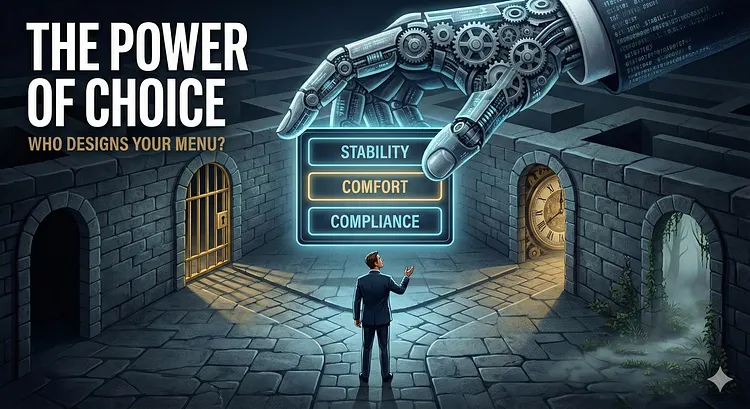
Power is Menu Control
Most people think they’re choosing their lives. They’re not.
They’re selecting from a menu they didn’t design, constrained by options they barely notice, mistaking motion for agency. What feels like freedom is often just compliance with better aesthetics.
Power is usually described as possession: money, authority, influence. That definition confuses instruments with leverage. A more precise definition is structural: power is control over the menu of meaningful alternatives available to you.
By meaningful alternatives, I mean options that are credible enough to pursue, survivable if they fail, and visible enough to be consciously evaluated. If you cannot realistically redirect your trajectory, what you experience as “choice” is merely movement inside a narrow corridor.
Motion is not freedom. Directional control is.
Choice Only Exists Where Alternatives Exist
Consider a loyal dog. Its devotion is sincere, but structurally powerless because it has no viable exit or competing future. Its loyalty is never tested.
Choice scales with the size, credibility, and visibility of the option set. Where alternatives are absent or invisible, choice collapses into compliance. Commitment without alternatives is not a virtue; it is a constraint wearing a flattering name.
This is why poverty is more accurately understood as option scarcity. Limited time, weak networks, missing information, and low bargaining power compress decision horizons. A person with few credible paths doesn’t “choose” caution; they adapt.
Modern Power Doesn’t Dominate — It Designs Menus
When real alternatives appear, life becomes harder before it becomes freer. Options introduce friction: opportunity cost, regret risk, and cognitive strain.
The powerless act quickly because delay is costly. The powerful hesitate because comparison is affordable. Friction is not a flaw in power; it is the admission price.
The most effective power today rarely relies on force. It structures incentives so certain choices feel natural and rewarded, while others quietly decay.
- Creators build businesses on algorithms, only to discover a single feed change can collapse earnings.
- Professionals optimize credentials that markets silently devalue.
- Workers trade time for money until their future decisions are pre-committed.
True power is not choosing well from a list. True power is deciding what appears on the list at all.
The Only Diagnostic That Matters
Freedom is not the absence of constraints. Freedom is the capacity to choose which constraints to accept because they expand long-term optionality.
Strip away the romance, and the test is simple: If you cannot clearly name credible alternatives to your current life, you are not choosing it. It is choosing you.
Option visibility is itself a form of power. Alternatives you cannot perceive are functionally nonexistent. So the real question is not “Am I free?” It is this: If I decided to leave intelligently — not impulsively — could I?
If the answer is no, freedom is an aesthetic preference, not a condition.